narwhale
The narwhale, also known as the sea unicorn, is the marine creature that Professor Pierre Aronnax, in his capacity as a specialist in natural history at the Paris Museum, publicly proposed as the identity of the mysterious sea monster in an article published in The New York Herald on April 30, 1867. This hypothesis became the central, widely accepted explanation for the sightings and collisions that had alarmed the maritime world, framing the ensuing global hunt before the true, man-made nature of the phenomenon was discovered.
Scientific Hypothesis and Public Theory
In his article, Aronnax argued that the inexplicable phenomenon was a giant narwhale, a cetacean armed with a formidable ivory tusk. He described the common narwhale as often reaching a length of sixty feet and possessing a sort of ivory sword or lance, as hard as steel, citing examples of such teeth found buried in the bodies of baleen whales and even piercing the undersides of vessels. To account for the damage inflicted on ships like the Scotia, Aronnax proposed increasing the narwhale's dimensions fivefold or tenfold and giving it a strength in proportion to its size. He imagined this weapon to be ten times stronger and the animal ten times more powerful, launched at a speed of twenty miles per hour, creating a collision capable of causing the specified catastrophe. He concluded by plumping for a sea unicorn of colossal dimensions, no longer armed with a mere lance but with an actual spur, like ironclad frigates or warships called "rams." This theory rallied a number of supporters and allowed for free play of the imagination, as the sea was seen as the only suitable setting for breeding such giants.
Contrast with Reality
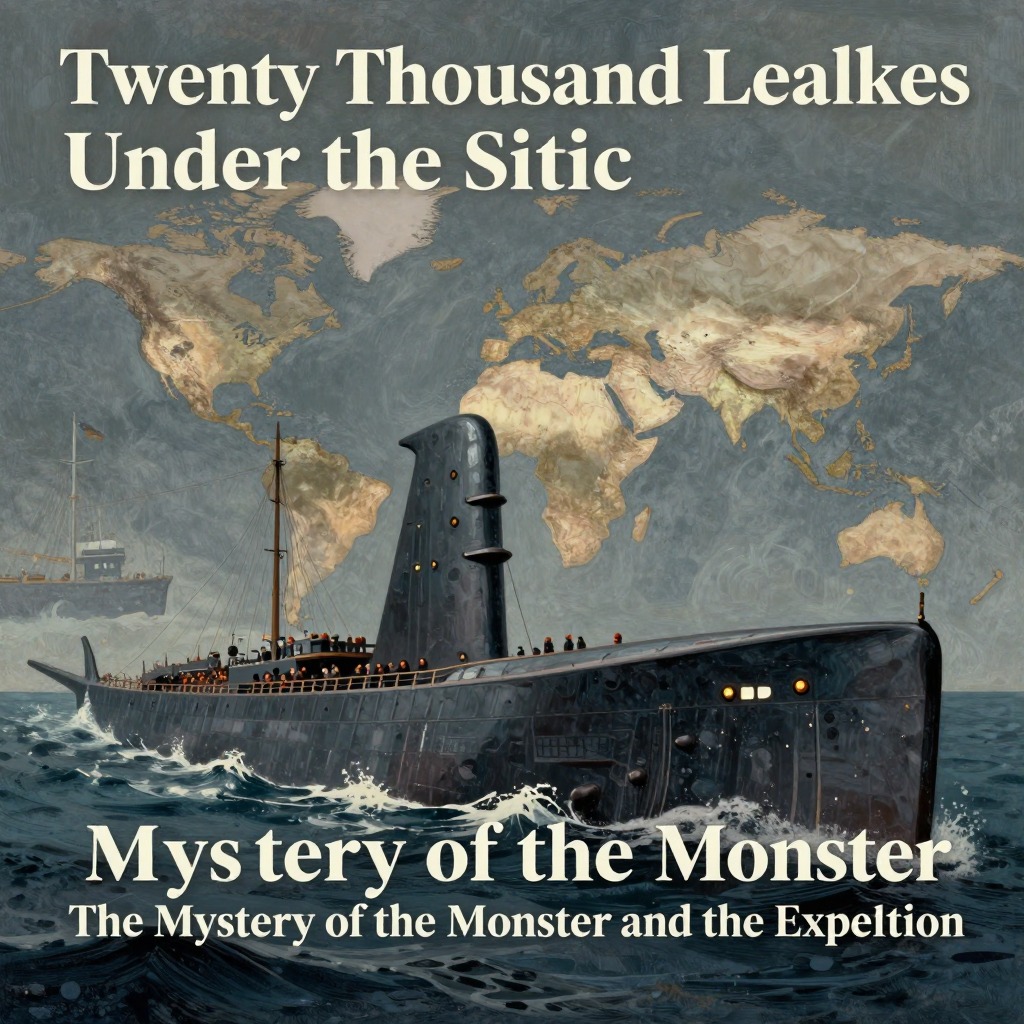
The narwhale hypothesis was definitively disproven when Aronnax, Ned Land, and Conseil were thrown overboard from the Abraham Lincoln and found themselves stranded on the back of the supposed monster. Ned Land realized his harpoon had blunted because the beast was made of boilerplate steel. Aronnax, upon testing it with his foot, found it to be a hard, impenetrable substance, not the soft matter of a marine mammal. The blackish back was smooth and polished with no overlapping scales, giving off a metallic sonority on impact, and seemed to be made of riveted plates. This discovery revealed the "monster" to be an even more astonishing phenomenon: a machine made by the hand of man, the Nautilus. The narwhale theory thus served as the crucial scientific misdirection that set the entire plot in motion, representing the limits of terrestrial science when confronted with a technology beyond its ken.